|
Appendicitis - How You Can
|
| Now Available! A Book That Exposes The Threat Posed By Sitting Toilets... |
 |
The widespread use of sitting toilets is the underlying cause of the high incidence of appendicitis in Western countries.
Although the connection between sitting toilets and appendicitis is not widely known in the West, it is nothing new.
Many other cultures have always recognized the wisdom of squatting for waste elimination.
Consider this warning which was given by Webhealthcentre.com, a health portal based in India:
| "The Indian type of toilet is more conducive to complete evacuation than the Western toilet. With the western style closets becoming popular in India, there is a risk of increased incidence of appendicitis." |
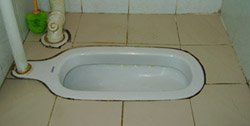
Also, several doctors also knew -- and have written extensively -- about the hazards of sitting for waste elimination.
For example, F.A. Hornibrook in The Culture of the Abdomen, published in 1933:
|
"Man's natural attitude during [elimination] is a squatting one, such as may be observed amongst field workers or natives. Fashion, in the guise of the ordinary water closet, forbids the emptying of the lower bowel in the way Nature intended. Now in this act of [elimination] great strains are imposed on all the internal organs..." |
This view was repeated in Our Common Ailment, written by H. Aaron and published in 1938:
|
"When the thighs are pressed against the abdominal muscles in this position, the pressure within the abdomen is greatly increased, so that the rectum is more completely emptied. Our toilets are not constructed according to physiological requirements. Toilet designers can do a good deal for people if they will study a little physiology and construct seats intended for proper [elimination]." |
How Squatting Protects The Appendix
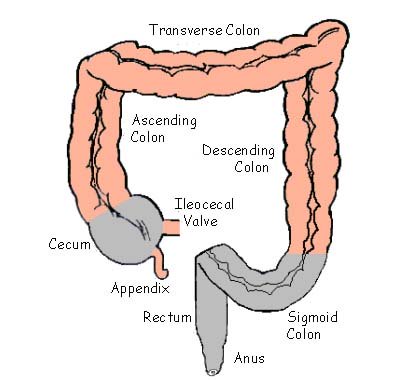
Human beings are designed to evacuate waste in the squatting position. This is reflected in the shape of the cecum, as well as its location and position in the body (right lower abdomen).
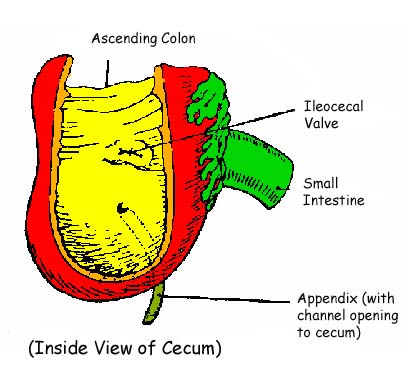
The cecum is shaped like a pouch. Wastes from the small intestine pass through the ileocecal valve to the cecum. The ileocecal valve acts as a one-way valve. Hence it would also prevent waste from flowing back into the small intestine.
In the squatting position, the right thigh - pressing against the right lower abdomen - squeezes the cecum from its base. This squeezing action pushes waste in the cecum away from the appendix and ileocecal valve, and up into the ascending colon.
The channel opening of the appendix stays clean.
The ileocecal valve stays securely closed.
In the sitting position, the cecum is not squeezed empty by the right thigh. Also, the colon is not prepared properly for evacuation. As a result, there is a need to strain and push downwards with the diaphragm, while holding one's breath.
This action inflates and pressurizes the cecum in the wrong direction (downwards) against the appendix and the ileocecal valve. It is like squeezing a tube of toothpaste in the middle, causing the bottom of the tube (cecum) to inflate.
This back pressure can force waste into the appendix, with disastrous consequences. It can also overwhelm the ileocecal valve, and cause waste to leak into the small intestine. (This contamination of the small intestine is the cause of Crohn's Disease.)
Hence, with sitting toilets, the waste in the cecum is not cleared completely. The residual waste adheres to the colon walls and the area of the channel opening of the appendix, increasing the risk of appendicitis, inflammation and cancer.
Conclusion
The appendix is not "poorly designed" or serves no purpose. Like the rest of the colon, it was designed with squatting in mind. The sitting toilet, by forcing users to sit, puts the appendix at risk.
The most effective way to prevent appendicitis is to use the squatting position for bodily functions.
For many, squatting is not something that is easy or comfortable. This is to be expected, as explained in this page on squatting facets. However, with regular practice, one can regain the ability to squat again.
This would then make it possible for one to switch from sitting to squatting, using one of the methods described on this
page.
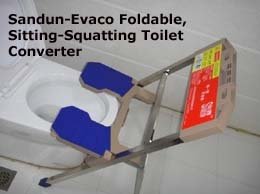
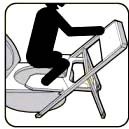
For many, however, the most practical option is to use a toilet squatting platform or converter.
Further Reading
1) The importance of the ileocecal valve and appendix
2) Fascinating facts about appendicitis and appendetomy
Go from Appendicitis to Home Page
Have A Great Story About This Topic?
Do you have a personal account about the topic discussed on this page? Please consider sharing it. You can be sure that many people in the world would love to read about and greatly benefit from your experience. It's easy to do. Just let your words flow. Thanks for sharing!
What Other Visitors Have Said
Click below to see contributions from other visitors to this page...
guffstuff Not rated yet
If you have to do so, you will find out what is happening. This will help. Tommy Olson.

The Best Toilet Converter in The World Today!


Helping People All Over
The World Achieve
Good Health Through
Correct Toileting Posture
Watch video on the
origin and story of
the Sandun-Evaco
toilet converter

All about Life,
Hope and Truth...

FREE:
One of the most
astounding books
you will ever read
in your life!