|
The Colon (Large Intestine)
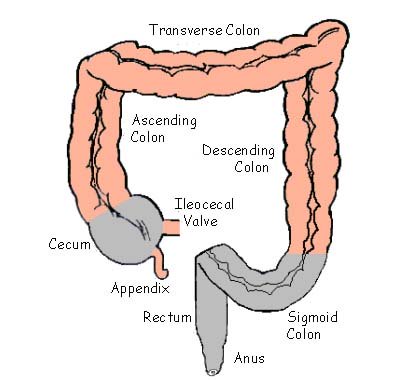
The colon or large intestine consists of (start from lower left) the cecum, ascending colon, transverse colon, descending colon, sigmoid colon, rectum and anus. Food wastes from the small intestines pass through the ileocecal valve into the cecum. It then travels through the colon, where it gradually solidify as water is continuously extracted from it.
The solid waste is then stored temporarily in the rectum before it is excreted through the anus. The colon is designed with squatting in mind. Among other things, it has natural built-in obstacles in the form of kinks and bends. One is a bend at the rectum which is released only when a person squats. The other bend is the kink where the sigmoid colon joins to the rectum. To release this kink, the sigmoid colon must be lifted up. This can only be achieved by the left thigh in the squatting position. There is one more thing... in the squatting position, the right thigh securely seals the ileocecal valve to allow proper pressurisation of the colon to expel waste. The right thigh also squeezes the cecum empty to keep it (and ileocecal valve and appendix) clean.
|

The Best Toilet Converter in The World Today!


Helping People All Over
The World Achieve
Good Health Through
Correct Toileting Posture
Watch video on the
origin and story of
the Sandun-Evaco
toilet converter

All about Life,
Hope and Truth...

FREE:
One of the most
astounding books
you will ever read
in your life!